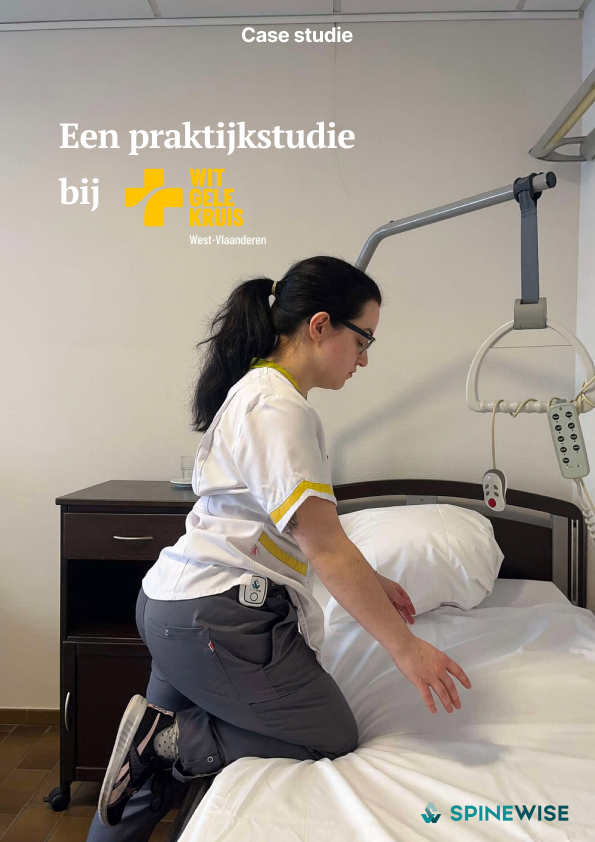
Back-friendly lifting: practical guidelines for prevention workers.
As a prevention officer, you play a vital role in preventing physical complaints in the workplace. One of the most common health problems is back pain, often caused by repetitive lifting.
Fortunately, many of these complaints can be prevented. This article provides a clear overview of how to help your employees lift ergonomically.
Why back pain from lifting is so common
Backs are subject to significant strain in certain sectors, such as construction, logistics, and transport. Prolonged, unfavorable postures or repeated lifting of heavy objects can strain the intervertebral discs, muscles, and ligaments.
Important risk factors include:
Lifting and carrying loads
Rapidly repeated movements
Push and pull
Few recovery moments
These factors are common at work and increase the risk of chronic back pain. Recent research by the Netherlands Center for Occupational Diseases shows that 16% of reported musculoskeletal complaints are back pain.
The ideal height for lifting something is between fist and elbow height. For the Belgian population, this equates to a height of approximately 90 to 105 cm.
According to European standards, the maximum weight you can lift manually is 25 kg under optimal conditions. If you have to lift higher or lower, the maximum weight you can safely lift decreases. Between knee and shoulder height, it is still safe to lift up to 20 kg. Above shoulder height or below knee height, you may only lift light objects. (Motmans, 2023) 3
The further the weight is from your body when lifting, the less you can safely carry it. The graph shows the safe weight based on the distance from the body (horizontally and vertically).
Please note: this graph does not take into account how often the weight is lifted or how strong the person is (as the load capacity can vary from person to person).

Organizational measures: limit lifting loads
Besides learning proper lifting techniques, organizational and environmental measures are equally important. As a prevention officer, you can make a difference in this regard.
Think about the workplace layout
A smart workplace design can prevent a lot of unnecessary lifting. Arrange the work environment so that employees work at an ergonomic height as much as possible – ideally between fist and elbow height. Also consider ways to avoid unnecessary movement of loads. Where possible, it's advisable to opt for height-adjustable workstations so the working height can always be adjusted to the user and the task.
Plan lifting moments strategically
Allow the heaviest lifting moments to occur early in the day or after breaks, when workers are relatively rested. Work-related fatigue affects lifting performance and increases the risk of incorrect movements.6 Short, planned recovery periods (micro-breaks) reduce muscle tension and cumulative strain.7
Encourage task variation
Prolonged or repetitive lifting increases the risk of overuse injuries. By alternating tasks and combining them with lighter tasks such as administrative work or quality control, the muscles are given the opportunity to recover.
During these rest periods, simple stretching exercises can be performed to promote recovery.
Varying your posture is also important. Regularly alternate between standing, sitting, walking, and lifting to reduce the strain.
Even with proper lifting technique, prolonged physical work remains strenuous. Regular short breaks help muscle recovery and reduce fatigue in the long run.
Policy tip: Anchor task variation in schedules and work instructions.
Make use of resources
Technical aids not only reduce physical strain, but also increase safety:
Electric lifting aids
Carts
Height-adjustable work tables
Please note in practice: Make sure that these aids are easily accessible.
Promote cooperation in heavy or awkward lifting work
Never allow employees to lift heavy, unstable, or difficult-to-handle loads alone. Ensure a culture where asking for help is accepted.
Communication suggestion: Remind employees: “If you are unsure whether it is too hard, do it together.”
The three basic principles of back-friendly lifting
Organizational measures aren't always quick to implement. If lifting is still required, ensure employees are well-informed about the correct handling and lifting of loads.
There are three core principles for back-safe lifting techniques. These principles provide a simple guideline for lifting loads in various sectors.
1. Wide and stable support base
Principle: Place both feet approximately shoulder-width apart and, if necessary, place one foot slightly in front of the other for extra stability.
Rationale: A wide base of support increases balance and control, reduces unexpected postural corrections, and ensures an even distribution of ground reaction forces. Research shows that stable foot placement can reduce trunk forces and co-contraction during lifting movements. 8 9
Organizational aspect: Ensure the workstation offers sufficient space for proper foot positioning. Limited freedom of movement increases the risk of twisted or forced movements, which increases the risk of strain.
Practical tip: Practice this first with a light weight; many employees are unaware of their foot placement.
2. Keep the load close to the body
Keep the load close to the body
Principle: Hold the object as close to the torso as possible, ideally around navel height.
Rationale: The lifting moment (moment arm) decreases as the horizontal distance from the torso decreases, which reduces compression and shear forces on the lumbar spine. Studies report significant increases in L4/L5 compression forces when loads are held just a few centimeters further from the body. 4 10 11
Practical tip: Organize the workspace so that objects are within reach and at a convenient height (fist-to-elbow height ≈ 90–105 cm for the Belgian population). Do not place heavy objects on the floor or above shoulder height.
3. Avoid twisting while lifting
Principle: Avoid torsion of the torso during lifting and carrying; move the feet and turn with the whole body.
Rationale: Torsion combined with flexion and compression is a known risk factor for disc injuries and low back pain. Biomechanical models and in vivo measurements show that asymmetric lifting movements (rotation) increase disc loading and muscle activation.12 13
Organizational aspect: Don't place lifting and lowering surfaces too close together. A short distance encourages employees to take a step to put down the load, rather than twisting their torso from a fixed foot position. A too-compact setup actually increases the risk of unwanted back strain.
Practical tip: "Head and feet point in the same direction." Train employees to move steps first and only then rotate the torso.
Conclusion
As a prevention officer, you're the link between policy and practice. By implementing organizational measures, clear lifting instructions, and encouraging behavioral changes, you can significantly reduce back pain in the workplace.
In summary:
Provide a well-designed and adaptable workplace.
Plan and distribute lifting loads during the working day.
Implement micro breaks.
Provide sufficient resources and encourage their use.
Work on a culture of collaboration and asking for help.
Train employees in lifting objects: wide stance, load close by, do not twist your torso.
With this approach, you not only support the health of employees, but also sustainable employability within the organization.
Citation
1. Dreischarf M, Rohlmann A, Graichen F, Bergmann G. In vivo loads on a vertebral body replacement during different daily activities. J Biomech. 2013;46(8):1413–1420.
2. Netherlands Center for Occupational Diseases. More than 2,600 occupational diseases reported by 690 occupational physicians in 2024. Available at: Beroepsziekten.nl
3. Motmans R. (2023, March 31). Maximum weight to lift? 25 kg and less. Ergonomics Site. Link
4. Hoozemans MJM, Kingma I, van Diën JH, et al. Effect of lifting height and horizontal load position on low back loading. Ergonomics. 2004;47(7):784–798.
5. Knapik JJ, Reynolds KL, Harman E. Soldier load carriage: Historical, physiological, biomechanical, and medical aspects. Mil Med. 2004;169(1):45–56.
6. Iridiastadi H, Nussbaum MA. Muscle fatigue and endurance during repetitive intermittent static efforts: development of prediction models. Ergonomics. 2006;49(4):344–360.
7. McGill SM. The biomechanics of low back injury: implications on current practice in industry and the clinic. J Biomech. 1997;30(5):465–475.
8. Granata KP, Marras WS. The influence of trunk muscle coactivation on dynamic spinal loads. Spine. 1995;20(8):913–919.
9. Plamondon A, Delisle A, Larivière C, et al. Biomechanical differences between lifting unconstrained and box-shaped unknown loads. Clin Biomech. 1997;12(4):254–262.
10. Kingma I, Faber GS, van Diën JH. How to lift a box that is too large to fit between the knees. Ergonomics. 2010;53(10):1228–1238.
11. van Diën JH, Hoozemans MJM, Toussaint HM. Stoop or squat: a review of mechanical studies on lifting technique. Clin Biomech. 1999;14(10):685–696.
12. Dreischarf M, Rohlmann A, Graichen F, Bergmann G. In vivo loads on a vertebral body replacement during different daily activities. J Biomech. 2013;46(8):1413–1420.
13. van Diën JH, Hoozemans MJM, Toussaint HM. Stoop or squat: a review of mechanical studies on lifting technique. Clin Biomech. 1999;14(10):685–696.